Friday, January 22, 2021

Signed Books: 2 – JOURNEY'S END

Among my collection of signed books are volumes given to me by writers who were also friends along with others by writers, actors and celebrities whom I interviewed while broadcasting on the BBC's radio arts programmes or encountered while making my various radio documentary series; but, over the years, I have also bought signed copies of books from second-hand book shops, on-line book dealers and at auction. 


Today's book is one such although I cannot now remember where I purchased this copy of Journey's End which recently surfaced in a box of books that hadn't been looked into for a number of years. What I certainly hadn't remembered was quite what a particular copy this is...


Journey's End is a noted play by English dramatist, R C Sherriff (Robert Cedric Sherriff, 1896-1975) set in the trenches near Saint-Quentin, Aisne, France, towards the end of the First World War. 


The drama plays out in the officers' dugout of a British Army infantry company from 18 to 21 March 1918 and giving an intimate portrait of the lives of a group of soldiers during the last few days before the onset of the major German military offensive known as Operation Michael.


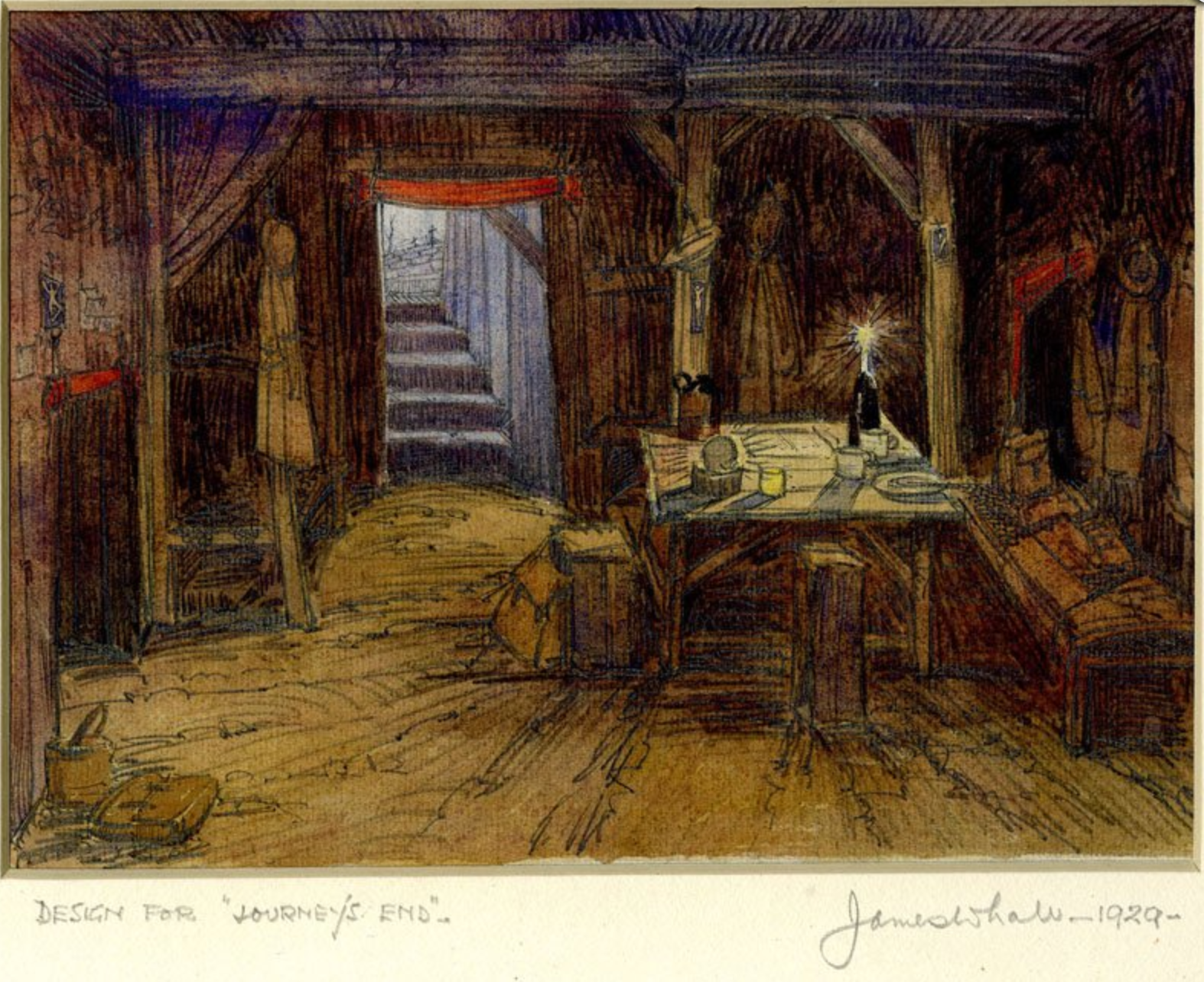
The Incorporated Stage Society on 9 and 10 December 1928 first staged the play, for two nights only. Directed by the then unknown James Whale (later director of many films including Frankenstein and The Bride of Frankenstein) and with George Zucco as Lieutenant Osborne and Maurice Evans as 2nd  Lieutenant Raleigh and the 21-year-old Laurence Olivier as Captain Stanhope.


The play moved to the West End first (with Colin Clive replacing Olivier) at the Savoy Theatre and then at The Prince of Wales where it had a two-year run. 


Included in The Best Plays of 1928–1929, the play quickly became internationally popular, with numerous productions and tours in English and other languages.


The first American production production debuted on Broadway on 22 March 1929 at Henry Miller's Theatre 124 West 43rd Street.


My copy of the play is the 1929 American edition from Bretano's Publishers and gives cast of that first New York run.


The play was once again directed by James Whale with Colin Keith-Johnston playing Stanhope and, in the role of Lieutenant Osborne – Leon Quartermaine.


Leon Quartermaine as Lieutenant Osborne in Journey's End by Eric Pape
lithographic crayon on paper, published 7 July 1929
National Portrait Gallery (NPG D48183)


What makes this copy of the play so particular, is that not only is it signed by Sherriff on the title-page, but is personally inscribed by the playwright (as 'Bob Sherriff') on the half-title to Leon Quartermaine...


In addition to the signatures on the pages of the book itself there is ('loosely inserted', as booksellers put it) a later-purchased autograph of Leon Quartermaine, inscribed “with pleasure”...


Leon Quartermaine (1876-1967) was born in Richmond, London on 24 September 1876 and educated at the Whitgift School in Croydon.


In 1921 Quartermaine appeared with Fay Compton in a West End revival of J M Barrie's play Quality Street and the following February Quartermaine and Compton were married, and remained so until their divorce in 1942.


In addition to his performance as Lieutenant Osborne in the American premiere of Journey's End Quartermaine made numerous appearances on Broadway between 1903 and 1935, among them Laertes (Hamlet, 1904) and Malvolio (Twelfth Night, 1930).


Quartermaine appeared in several films during the ‘twenties and ‘thirties, including As You Like It (1936) in which he co-starred as Jacques to Laurence Olivier's Orlando. 


After the Second World War, Quartermaine joined the Royal Shakespeare Theatre for the 1949-50 Stratford Festivals, in a company including John Gielgud, Peggy Ashcroft, Anthony Quayle and other leading Shakespearean actors, appearing in Macbeth, Measure for Measure and Much Ado About Nothing. In 1951 he played the Inquisitor in a BBC television adaptation of Shaw's Saint Joan.


Quartermaine died on 25 June 1967, in Salisbury, Wiltshire.


Wednesday, January 20, 2021

Signed Books: 1 – Mary Poppins and the House Next Door

This is the first of an occasional series of posts in which I'll be sharing details of signed volumes in my book collection.

I start with P L Travers' Mary Poppins and the House Next Door, the last story about the magical nanny.


I have a number of books inscribed and signed by Travers, but I've chosen this particular title because it was her last, because she gave it to me when it was first published in 1988 and because, at that time, we were working together for the Walt Disney Studio on Mary Poppins Comes Back a planned (but unrealised)
sequel to the Studio's celebrated 1964 Oscar-winning triumph.  

This also gives me the opportunity to re-post an essay I wrote fifteen years ago about my very first encounter with the woman who gave us the Practically Perfect Mary Poppins...


TEA WITH MARY POPPINS

I was going to tea with Mary Poppins! 

Well, no, not exactly, but I was going to tea with P L Travers, who had written the Mary Poppins books; and, at that precise moment, I was walking down a street of neat-and-tidy-looking houses that reminded me very much of Cherry Tree Lane…

True, Shawfield Street – off the King's Road in London’s Chelsea – didn’t boast any really grand houses (with two gates) like that owned by Miss Lark and none of them were quite as unusual or as exciting as the ship-shape home of Admiral Boom… But, as I arrived at the door of number 29, I felt as if I might expect to find Robertson Ay asleep on the doorstep or hear the argumentative voices of Mrs Brill and Ellen coming up from the basement.

This all happened over twenty years ago, but I remember it now as vividly as if it were only yesterday…

I'd been invited to come to tea at four o'clock and I was a little early – ten minutes early to be precise – because I really didn't want to be late and keep Mary Poppins waiting...

I went up the steps to the front door – which, rather surprisingly, was painted candyfloss pink – and I rang the bell.

Silence.

I rang again.

Still silence.

Had I got the wrong day, I wondered.

Then a window, two storeys up, flew open and a head popped out and asked, in a brisk tone: "Are you Brian Sibley?"

I said that I was.

"Well," said the head, "you are early!" And the window rattled shut again.

I waited. And I waited. For the full ten minutes I waited – until the clock on a nearby church struck 'four'. Only then did a woman with curly grey hair and bright forget-me-not-blue eyes open the door.

So, this was P (for Pamela) L (for Lyndon) Travers…


I noticed that she was wearing a pair of 'sensible shoes' of the kind Mary Poppins wore; but, in contrast, she sported a very un-Poppinsish dress with lots of frills and flounces, a number of jingly-jangly bracelets and bangles (rather like those favoured by Miss Lark, I thought) and a chunky turquoise necklace.

After my wait on the doorstep, I was a little nervous, but she welcomed me in with a smile, threw my coat over the back of a noble rocking-horse who galloped up the hallway and showed me into the room where, many times afterwards, I would come to have tea and talk with the woman who introduced the world to Mary Poppins.

When Jane and Michael Banks once asked Mary Poppins who she would choose to be if she wasn't Mary Poppins, she replied, in her sharp, non-nonsense tone: "Mary Poppins." It is a typical Poppins response: supremely confident, yet – at the same time – as mysterious and elusive as the place where a rainbow ends…

And, sometimes, P L Travers could be much the same. For one thing, that was not her real name: when she was born, in Australia in 1899, she was called Helen Lyndon Goff.

Then, as a young woman she became an actress and a dancer and took 'Pamela' for a stage name (because she thought it sounded pretty and "actressy"), followed by 'Lyndon' (her own second name and a reminder that her ancestors came from Ireland, the land of myths and stories) and, finally, 'Travers' which was her father’s first name. 

Travers Goff had died when Pamela was seven-years-old and she never forgot how much she had loved and missed him. Mr Banks in the stories is, in some respects perhaps, owes something to her father and, although Pamela used to tell people that he was a sugar-planter in Australia, in truth at the time that she was born Goff was working in a bank – just like Jane and Michael’s father.

It was never easy to get factual detail from Pamela and she was especially enigmatic is asked about the creative processes behind her book. She would get especially irritated if you asked about how she came to 'create' Mary Poppins. firmly making it clear that she had 'discovered' rather than 'invented' the character – but, as with so many things in Pamela’s life, you never quite knew… 


She told me, for instance, that Mary Poppins had first blown into her imagination – rather as she blows into the lives of the Banks family – when she was recovering from an illness in an old country cottage in Sussex. She said that somewhere – in that strange state between being ill and getting better – the idea of a person like Mary Poppins had come to her. 

The truth is that, several years earlier, she had written a short story entitled 'Mary Poppins and the Match Man' that was published in a New Zealand newspaper and this story was, in fact, an early version of the second chapter of Mary Poppins in which Bert accompanies her on her 'Day Out' and they enjoy a wonderful tea with heaps of raspberry jam-cakes! 


What is certain is that, during that illness, she came up with ideas for new stories about the character and wrote them down. Mary Poppins, was published in 1934, with illustrations by Mary Shepard, the daughter of the man who had drawn Winnie-the-Pooh. 


The following year, she wrote her second book, Mary Poppins Comes Back, and, after a nine-year gap, the third book in the series appeared. Pamela had wanted to call it Good-bye, Mary Poppins, but eventually – after her publisher begged her not to be quite so final – it was renamed Mary Poppins Opens the Door.

And, as it happens, it wasn't goodbye to Mary Poppins because, eight years later, she wrote Mary Poppins in the Park following which the practically perfect nanny reappeared in various spin-offs including an alphabet book Mary Poppins from A to Z (which, for some reason, was subsequently translated into Latin) and a book of stories and recipes entitled Mary Poppins in the Kitchen. Late in life, the author wrote two more slim volumes: Mary Poppins in Cherry Tree Lane and, finally in 1988, Mary Poppins and the House Next Door.
 

"If you are looking for autobiographical facts," P L Travers once wrote, "Mary Poppins is the story of my life." This seems an unlikely claim when you think that Mary Poppins goes inside a chalk pavement picture, slides up banisters, arranges tea-parties on the ceiling and has a carpet bag which is both empty and yet contains everything.

But if we take her at her word, we can find many things in her books that spring from her own life and shaped the stories she told…

For example, several of her fictional characters have names borrowed from people Pamela had known in her childhood - among them a strange little old woman with two tall daughters who ran the local general store where the young Pamela bought sweets. Her name, of course, was – as it is in the stories – Mrs Corry.

As for Miss Poppins herself, her first name was probably inspired by the younger of Pamela’s two sisters who was known in the family as 'Moya' – the Irish version of ‘Mary’.

As for 'Poppins'… Well, Pamela never gave any clues as to where that name came from. But when she first arrived in London to work as a journalist, she used an office near Fleet Street and on her way to visit nearby St Paul's Cathedral – home to the Bird Woman – she would have passed a little lane with the curious name, 'Poppins Court'.


Unlike today's street signs, early London gazetteers did not include the apostrophe and 'Poppins Court' was once the site of a 14th Century inn called 'The Poppinjay' that was owned by the Abbots of Cirencester and had an inn-sign displaying the Abbey's crest: a parrot-like bird.

And while we're talking parrots...

Although she and her sisters never had a Mary Poppins for a nanny, they did have an Irish maid named Bertha –– or maybe she was called Bella, Pamela pretended she could never quite remember! Bella (or Bertha) was a marvellous character with almost as many eccentric relatives as Mary Poppins.

What’s more, Bertha – or Bella – possessed something that was her pride and joy: a parrot-headed umbrella. "Whenever she was going out," Pamela once told me, "the umbrella would be carefully taken out of tissue-paper and off she would go, looking terribly stylish. But, as soon as she came back, the umbrella would be wrapped up in tissue-paper once more."

You will remember that Mary Poppins always carried her umbrella, regardless of the weather, simply because it was too beautiful not to be carried. "How could you leave your umbrella behind," asks the author, "if it had a parrot’s head for a handle?"


"Spit-spot into bed," was a favourite phrase of her mother's, and other bits of Mary Poppins' character were clearly inspired by Pamela's spinster aunt, Christina Saraset, whom everybody called 'Aunt Sass'. She was a crisp, no-nonsense woman with a sharp tongue and a heart of gold who, like Mary Poppins, was given to making "a curious convulsion in her nose that was something between a snort and a sniff."

When Pamela once suggested to her aunt that she might write about her, the elderly lady replied: "What! You put me in a book! I trust you will never so far forget yourself as to do anything so vulgarly disgusting!" This indignant response was, apparently, followed up with a contemptuous, "Sniff, sniff!" 


Now, doesn't that sound just like Mary Poppins? Certainly I can report that P L Travers herself said something along the same lines to me, when I rashly suggested, one day, that I might write her life-story!

As a young girl, Pamela took dancing lessons and there seems to be dancing, of some kind or other, in every one of the books: remember Mary Poppins joining all the birds and beasts at the zoo in dancing the Grand Chain? Or the Red Cow who catches a falling star on her horn and can't stop dancing?


And, speaking of stars, reminds me that, as a child, Pamela had been captivated by the beauty of the constellations she saw in the clear southern skies above her home in the Australian outback. She never lost her fascination with star-gazing and there are stars scattered throughout the pages of all her books. In one story, Maia (one of the stars in the constellation Pleiades), comes down to earth to do her Christmas shopping; in another, Mrs Corry, her two gargantuan daughters and Mary Poppins paste Gingerbread Stars on to the night sky.


Over the years I knew Pamela, we had many conversations but the one I remember most clearly took place not long before she died at the grand age of 96 and it was also about a star.

I had asked her if she thought perhaps another story – maybe one last tale about Mary Poppins – might come to her. "I think it might," she replied slowly, "because, the other day, on the street outside, I found a star on the pavement!"

"A star?" I repeated, with surprise.

"Yes," she said softly, "a star. Go and look for it yourself. I hope I shall find out where it came from and what it is doing there."

It was dusk when I let myself out of the candy-pink door of 29 Shawfield Street that particular afternoon and headed off to look for that star. Light was failing, but I found it, at last: just as Pamela had said – a star-shape, faintly but clearly marked in the surface of a paving stone.

A puzzled passer-by looked quizzically at the man staring intently at what looked like a very ordinary piece of pavement. 


Doubtless it was some rouge imprint on the surface from the manufacturing of the cement paving-stone, but I was remembering the words of the old snake, the Hamadryad, on that night of the full moon when Mary Poppins took Jane and Michael to the zoo:


"We are all made of the same stuff... The tree overhead, the stone beneath us, the bird, the beast, the star - we are all one, all moving to the same end..."


Like Mary Poppins, P L Travers saw – and gave others the ability to see – the magical in very ordinary and everyday things.


She had discovered something as rare and amazing as a star in a London street and, then, she had given it away...

I hope she found out why it was there…

Of course, Mary Poppins would have the answer, but, as you know, she would never, never tell...


© Brian Sibley, 2006, 2021

Illustration: Mary Poppins and the Hamadryad by Culpeo-Fox; all other illustrations by Mary Shepard 

Thursday, October 31, 2013

A LEAF FROM THE HALLOWEEN TREE

Here's a fantastical print by Joe Mugnaini's illustrating Ray Bradbury's wonderful book The Halloween Tree...


Thursday, February 14, 2013

THE PHILOSOPHY OF LOVE

 According to Aristotle...


LOVE is composed of a single soul
inhabiting two bodies


Alternatively, it's a big one of these...


Aristotle by Wendell B Johnson

Saturday, February 02, 2013

HEART ATTACK!

A zillion years ago when I was at school, I played the police inspector in a stage version of Edgar Allan Poe's classic short story The Tell-Tale Heart.

As a kid with a highly developed sense of morbidity, I adored Poe (along with many of his later, less sophisticated, imitators) and enjoyed the thrill of scaring myself silly by reading such tales of horror and terror late into the night! After reading Poe's The Premature Burial, I left a note by my bed, telling my parents, in the event of my death, to get at least three doctors to verify my decease before committing me to the sod!

I recently heard from Garrett DeHart, a talented young filmmaker that he had made a short film that took a new twist on Poe's The Tell-Tale Heart. Entitled, If I am Your Mirror, it is dark and brooding and filled with bloody violence (warning over for the faint of heart!) but a superbly accomplished piece of filmmaking from someone from whom I confidently expect to hear more.


If I Am Your Mirror is Garrett DeHart's graduate thesis film. He filmed the actors in a chromakey studio and developed an animation technique to simulate an animated oil painting. He did all the post production himself over a two-year period and the film was produced with a budget under $5000!

Click to find out more about Garrett DeHart

Image: Mr Poe by Hugomaster

Tuesday, January 01, 2013

RING IN THE NEW!


"...So may the New Year be a happy one to you, happy to many more whose happiness depends on you! So may each year be happier than the last, and not the meanest of our brethren or sisterhood debarred their rightful share, in what our great Creator formed them to enjoy!"


Charles Dickens The Chimes (1843)

Thursday, November 29, 2012

THE FIRST NARNIAN

 Today is the birth-date of C. S Lewis...


"Miracles are a retelling in small letters of the very same story which is written across the whole world in letters too large for some of us to see."

Images: Time magazine cover, 8 September 1947, by Boris Artzybasheff
Painting of Narnia by Pauline Baynes

Friday, September 28, 2012

CURD THE LION


For some time now, I have been meaning to blog about Alan Gilliland's delightful book for children (their parents and the young at heart in general) The Amazing Adventures of Curd the Lion (and Us!) in the Land at the Back of Beyond.

It is a heady mix of the tried and trusted format featuring nursery-toys-come-to-life with riddling, punning, nonsense in the style of Lewis Carroll and Edward Lear punctuating a twisting, turning roller-coaster adventure story filled with dangers, outlandish encounters and weird and wonderful beings.

It all begins when the Great Raven steals a precious brooch belonging to the mother of twins Henry and Henrietta who get the blame and (worse) are told that, unless the brooch is returned, their imminent birthday party will be cancelled and their four beloved 'animals' will be unceremoniously en route to the local charity shop. Oh, the callousness of parents in literature – and life!

The motley quartet: Curd the Lion (named, obviously for the heroic Richard I), Pilgrim Crow, O'Flattery the Snake and a hyena named Sweeney the Heenie set out at once for the Back of Beyond to find the Great Raven and the recover the purloined brooch .


Along the way they are helped or hindered by a cavalcade of memorable characters, among them Professor Balloonafuss (who, like the Great and Terrible Oz, has an over-inflated sense of his own importance), His Majesty King Much of a Muchness, the mine-goblins, Nook and Cranny, Queen Mumbie-Bumbee, the Minorbore and Sir Rush and his Kalandar.


Eventually they succeed in reaching the Rocks of Brimstone and the out-jutting Corbie-stone, lair of the Great Raven, where friends and foes come together as the story reaches its dramatic climax.

There are a mass of subtexts and literary and historical allusions within the story (it is not accidental, for example, that the creature encountered named the 'Dodongs' is an anagram of that Carrollian alter ego, 'Dodgson') and readers armed with the map below can trace the route of Curd & Co's adventures in the real location of Brimham Rocks in the Yorkshire Dales.

With delightful illustrations by the author, this a perfect read-aloud book for bedtime readers  – and their listeners!

Visit Alan Gilliland's website for more information about this and his other books. And you can read many more glowing reviews of this unique and wonderfully quirky book on Lovereading4kids.


Tuesday, July 17, 2012

Wednesday, July 11, 2012

BLACK & WHITE & IN THE PINK

I only need to glimpse this Puffin Books cover art by Janet and Anne Grahame Johnson for Dodie Smith's wonderful The One Hundred and One Dalmatians, to be transported back to my childhood and a Christmas Day spent rapt in a captivating adventure story of heroic, talking dogs.


Having fallen in love with this deliciously fanciful book, I later succumbed to the stylish, witty Disney movie. Both now happily co-exist in my memories of youthful plreassures!


Wednesday, July 04, 2012

CROCODILE TEARS

To mark the 150th anniversary of the first telling of the story that would become Alice's Adventures in Wonderland, here is one of Lewis Carroll's poetic parodies from that book that is now better known than the original verse that Carroll was lampooning...


How doth the little crocodile
Improve his shining tail,
And pour the waters of the Nile
On every golden scale!
How cheerfully he seems to grin,
How neatly spreads his claws,
And welcomes little fishes in
With gently smiling jaws!

The original was entitled 'Against Idleness and Mischief' by Isaac Watts and appeared his 1715 book, Divine and Moral Songs for the Use of Children... 
How doth the little busy bee
Improve each shining hour
And gather honey all the day
From every opening flower!
How skillfully she builds her cell!
How neat she spreads the wax!
And labours hard to store it well
With the sweet food she makes.
In works of labour or of skill,
I would be busy too;
For Satan finds some mischief still
For idle hands to do.
In books, or work, or healthful play,
Let my first years be passed,
That I may give for every day
Some good account at last.
I know which I prefer!

You'll find more ramblings in Wonderland here and, again, here.

Image: Crocodile by Darren Hopes

Wednesday, June 27, 2012

READING IS BLISS


Reading is everything. 

Reading makes me feel like I've accomplished something, learned something, become a better person. 

Reading makes me smarter. 

Reading gives me something to talk about later on. 

Reading is the unbelievably healthy way my attention deficit disorder medicates itself. 

Reading is escape, and the opposite of escape; it's a way to make contact with reality after a day of making things up, and it's a way of making contact with someone else's imagination after a day that's all too real. 

Reading is grist. 

Reading is bliss.

From I Feel Bad About My Neck: And Other Thoughts on Being a Woman
by Nora Ephron (1941-2012)


Photo: REUTERS


Monday, April 23, 2012

Wednesday, April 04, 2012

A FASCINATING RESULT

Let me express my gratitude to all my readers who voted for this blog in the recent Most Fascinating Blog awards.

Although it didn't win, my nominated posting about P L Travers and Mary Poppins earned Ex Libris 10th place out of the 93 blogs that were in the running for the award.

Thank you!

Wednesday, March 21, 2012

WHAT IS THE GRASS?

The United Nations has decreed that today in World Poetry Day

This is the sixth section of
Walt Whitman's glorious
'Song of Myself'
from Book III of
Leaves of Grass...


A child said What is the grass? fetching it to me with full hands;
How could I answer the child? I do not know what it is any more than he.

I guess it must be the flag of my disposition, out of hopeful green stuff woven.

Or I guess it is the handkerchief of the Lord,
A scented gift and remembrancer designedly dropt,
Bearing the owner's name someway in the corners, that we may see and remark, and say Whose?

Or I guess the grass is itself a child, the produced babe of the vegetation.

Or I guess it is a uniform hieroglyphic,
And it means, Sprouting alike in broad zones and narrow zones,
Growing among black folks as among white,
Kanuck, Tuckahoe, Congressman, Cuff, I give them the same, I receive them the same.

And now it seems to me the beautiful uncut hair of graves.

Tenderly will I use you curling grass,
It may be you transpire from the breasts of young men,
It may be if I had known them I would have loved them,
It may be you are from old people, or from offspring taken soon out of their mothers' laps,
And here you are the mothers' laps.

This grass is very dark to be from the white heads of old mothers,
Darker than the colorless beards of old men,
Dark to come from under the faint red roofs of mouths.

O I perceive after all so many uttering tongues,
And I perceive they do not come from the roofs of mouths for nothing.

I wish I could translate the hints about the dead young men and women,
And the hints about old men and mothers, and the offspring taken soon out of their laps.

What do you think has become of the young and old men?
And what do you think has become of the women and children?

They are alive and well somewhere,
The smallest sprout shows there is really no death,
And if ever there was it led forward life, and does not wait at the end to arrest it,
And ceas'd the moment life appear'd.

All goes onward and outward, nothing collapses,
And to die is different from what any one supposed, and luckier.

Monday, February 27, 2012

HOW FASCINATING?

This blog is one of 93 blogs nominated for the Most Fascinating Blog of 2012 Award! It was this posting about P L Travers and Mary Poppins that won me the nomination from a pool of over 2,300 submissions!


And now you, gentle reader, can now take part in voting it the MFB of 2012!

UPDATE: Voting is now closed

Tuesday, February 14, 2012

A VALENTINE VERSARY

A
VALENTINE
Greeting
from one of my all-time favourite versifiers,
Mr OGDEN NASH

To My Valentine

More than a catbird hates a cat,
Or a criminal hates a clue,
Or the Axis hates the United States,
That's how much I love you.

I love you more than a duck can swim,
And more than a grapefruit squirts,
I love you more than a gin rummy is a bore,
And more than a toothache hurts.

As a shipwrecked sailor hates the sea,
Or a juggler hates a shove,
As a hostess detests unexpected guests,
That's how much you I love.

I love you more than a wasp can sting,
And more than the subway jerks,
I love you as much as a beggar needs a crutch,
And more than a hangnail irks.

I swear to you by the stars above,
And below, if such there be,
As the High Court loathes perjurious oathes,
That's how you're loved by me.

Image: Autograph and self-portrait by Ogden Nash


Signed Books: 2 – JOURNEY'S END

Among my collection of signed books are volumes given to me by writers who were also friends along with others by writers, actors and celebr...