Sunday, April 11, 2010

CELEBRATING SEARLE

Originally posted on the Sibleyblog on 3 March, 2010, the 90th birthday of the greatest cartoonist of the late 20th century.

Click image to enlarge

RONALD SEARLE is universally remembered for his infamously anarchic educational establishment, St Trinian's, whose young ladies were later immortalised on film under the tutelage of Miss Milicent Fritton (first portrayed by Alastair Sim and, more recently, by Rupert Everett) and who are here seen, in one of the original drawings, turning out to greet an honoured guest on Founder's Day - could it be the artist himself? I think so...

Click image to enlarge

I first encountered Searle not on the hockey-pitch of St Trinian's but through his illustrations to the fairytale worlds of James Thurber's The 13 Clocks and the Wonderful O...


Shortly afterwards, I became acquainted with (right) Searle's graphic contribution to the academic misadventures of Master Nigel Molesworth who - "as any fule kno" - was the Curse of St Custard's.

Despite the fact that Searle's collaborator was a former teacher, Geoffrey Willans, Down with Skool, How to Be Topp and their companion volumes were widely condemned by educationalists in my day (and certainly banned from my skool library) due to their appalling spelling and grammar and, more heinously, their highly subversive content!

Today, changing social mores not withstanding, they remain an hilarious insight into the monstrous minds of small boys!

"The Molesworth-Peason lines Machine.
Runs off a hundred in one minit. (patnt pnding.)"
Click image to enlarge

During my own passage from adolescence to adulthood, I discovered Searle's many collections of cartoons and pen portraits as well as some of his illustrations to an astonishing range of books by authors ranging from Charles Dickens via Christopher Fry to Patrick Campbell.

Searle, I found, had also decorated the lyrics of Tom Lehrer, Flanders and Swann and, in the animated film, Dick Deadeye, the stories and characters of Gilbert and Sullivan.

I also stumbled across (left) his spidery 'embellishments' to a delicious oddity, The Journal of Edwin Carp, written by the actor Richard Haydn (fondly recalled as Max Dettweiler in The Sound of Music) which inspired this short animated film...


Ronald Searle was an artist of enormous diversity, whose work spans over sixty years of contributions to Lilliput, Punch, Life, Holiday, La Monde and many other publications containing his idiosyncratic observations on life in Britain...

Click image to enlarge

France, where he eventually made his home...

Click image to enlarge

And the USA...

Click image to enlarge

Searle's established brilliance as a caricaturist, led to his designing several memorable movie posters and title sequences for a number of films including Scrooge, Monte Carlo or Bust and Those Magnificent Men in their Flying Machines...

Click image to enlarge

During WWII, Searle had undergone the harrowing experience of being a Japanese POW in Changi Gaol and having witnessed torture and death at such close range may well have contributed, obliquely, to the comic violence found in the corridors, dorms and labs of St Trinian's and St Custard's. They certainly seem to haunt many of his later, darker cartoons, but the humour always bubbles through especially in his much-loved universe of bizarre birds, preposterous pigs and corpulent, contented cats...

Click image to enlarge

The work of this brilliant artist is currently being celebrated in two major London exhibitions:

Ronald Searle - Graphic Master is on show from 3 March-4 July at The Cartoon Museum, 35 Little Russell Street, London, WC1A 2HH. Opening hours: Tuesday-Saturday, 10:30-17:30; Sunday, 12:00-17:30, Closed Monday.

This glorious exhibition celebrates the creator of Molesworth and Co and the 'Surly gurls' of St Trinian's with some memorable scholaric moments such as this one...

"Ruddy Sports Day!"

The exhibition places Searle's cartoons, caricatures and illustrations within the historical context of graphic art as represented by such predecessors as Gilray, Cruikshank and Rowlandson. It also expands our appreciation of Searle's brilliance as a master of graphic reportage as demonstrated in a wide range of works from scenes of London life (sewer-men, flag-makers, boxers, and auctioneers) made during the 1950s for the News Chronicle and which are an evocative insight into London life in the early days of the 'New Elizabethan Age', through to Searle's globe-trotting observations of other cultures, by turn, brutally harsh and wryly affectionate.

Among the exhibits (many borrowed from the artist and his family and several of them unpublished and seen here for the first time) are plenty of pictures that make you smile, chortle and laugh out loud at the follies and absurdities of human nature, as well as others that will evoke quite different emotions such as Searle's painful and horrific war-time sketches of disease and death in the Burmese jungle and his clinical post-war chronicling of the trial of Adolf Eichmann and an emotional response to the erection of Berlin Wall.

A fabulous, full-colour 160 page catalogue (right) contains - in addition to a superabundance of Searleiness - essays and art-pieces by Steve Bell, Roger Law, Uli Meyer, Arnold Roth, Martin Rowson, Gerald Scarfe, Posy Simmonds and Ralph Steadman. At £14.99 it is a 'snip'.

If you love Ronald Searle - or even if just quite like him - you must not miss this exhibition!

The Cartoon Museum, 35 Little Russell Street, London, WC1A 2HH.
Opening hours: Tuesday-Saturday, 10:30-17:30; Sunday, 12:00-17:30, Closed Monday.

'Palm Springs' from The Cartoon Museum exhibition

There is also a largely-selling exhibition, Happy 90th Birthday Ronald Searle, from 3 March - 3 April at Chris Beetles Gallery.

Among the exhibits that are on loan (rather than for sale) in the Beetles show - which traces Searle's draughtsmanship from Lilliput to his illustrations, a year or two back, for Jeffrey Archer's Cat O'Nine Tales - is our very own Searle original: a classic St Trinian's cartoon showing the long-suffering headmistress and one of the little devils in her charge...

Click image to enlarge

On a blog post of a few years back, you can read more about this picture and about some of Searle's other work.

Chris Beetles Gallery, 8 & 10 Ryder Street, St James's, London, SW1Y 6QB.
Opening hours: 10:00-17:30pm Monday-Saturday. Closed Sunday.


And, after all that, all that remains to be said is....

Many Happy Returns, Mr Searle!


Several of the illustrations in this post have been 'borrowed' from my good friend, artist and animator, Matt Jones' blogs: Perpetua - Ronald Searle Tribute and Ronald Searle Tumblog, which are the places to go to read and see more - a lot more - about the work of this incomparable artist.

And check out Matt's other blogs:
Matt Jones' Sketchbook
Matt's Morgue
Mis-en-scene and others.

Incidentally, Matt will be giving a talk about Searle's work with animation at the Cartoon Museum on Tuesday 30th March. A month later (more or less) on Wednesday 28 April, I will be speaking about Searle's illustrations. There will be a number of other talks during the run of the exhibition and I'll give details as soon as they are available. All talks will begin at 6:30.

Saturday, December 20, 2008

A DICKENS OF A TALE

This seasonal post is reprinted from the Sibleyblog, 13 December 2006...

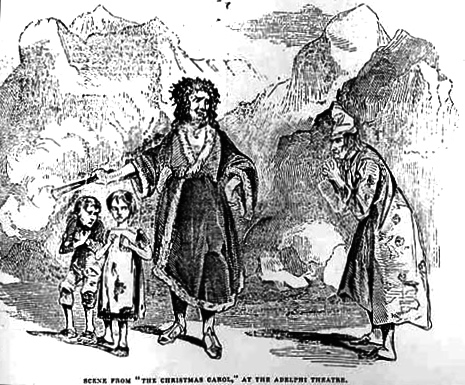
It's got apparitions, transformations and all manner of scenes from the frenzied delights of a Christmas ball to ghostly goings-on in a graveyard.

A Christmas Carol might almost have been written for the stage and it certainly has been on the stage at sometime or other for pretty much every one of its 163 years.

Take this Christmas [2006], for example: there will be revivals of Leslie Bricusse’s all-singing version and Christopher Gable’s all-dancing production; with famous former-Fagin, Ron Moody taking on a new Dickensian persona in Swansea as Ebenezer Scrooge and Michael Barrymore (above) reprising his portrayal of the role on tour.

It was in December 1843, that Dickens - angered by the terrible poverty of his day - published this little 'ghost story of Christmas', recounting the reformation of a mean-spirited man for whom December 25th and all associated with it is nothing more than "HUMBUG!" Though scarcely more than a novella, Dicken's Carol is crammed with memorable characterisations - living and spectral - and a series of rich descriptions of Christmas traditions and celebrations.


Within two months, there were no less than eight dramatised versions of A Christmas Carol being simultaneously presented on the London stage.

In order to avoid confusion, the titles were different - but only just! One was called A Christmas Carol, or the Miser's Warning; another A Christmas Carol, or Past, Present, and Future; a third A Christmas Carol, or Scrooge the Miser's Dream, or, The Past, Present, and Future...


One of the first performers to portray Scrooge was the celebrated Victorian actor, O. Smith, whose performance was described by Dickens as “drearily better than I expected”, adding that he found it “a great comfort to have this kind of meat underdone” - something which cannot be said of all his successors!

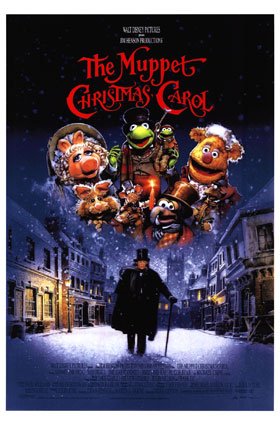
2006’s Scrooge’s - whether professional or amatuer - are the latest in a long line of performers to play the “squeezing, wrenching, grasping, scraping, clutching, covetous old sinner” and distinguished humbugs have included veteran thespians Bransby Williams and Seymour Hicks who both began by playing the part in legitimate theatrical productions before transforming their performances into solo music hall turns and then ending up among the first screen Scrooges - succeeded by the likes of Alistair Sim (for many the greatest of Scrooges), Albert Finney, George C Scott and Michael Caine in the much-loved musical version The Muppet Christmas Carol.


There has been an Ebenezer Scrooge for every possible taste from Anthony Newley to Anton Rodgers; from the senior partner of Steptoe and Son, Wilfred Brambell, to Star Trek's Jean-Luc Picard, Patrick Stewart (right); and employing every conceivable medium from a mime performed by Marcel Marceau to an opera sung by Sir Geriant Evans.

'Scrooging' has long been a popular pastime among knights of the theatre: Laurence Olivier, Ralph Richardson and Alec Guinness all did it on radio, Michael Hordern did it on television and John Gielgud on record. Others who have read the story on disc, tape and CD include Geoffrey Palmer, Richard Wilson, Ronald Coleman, Vincent Price and Leonard Rossiter.

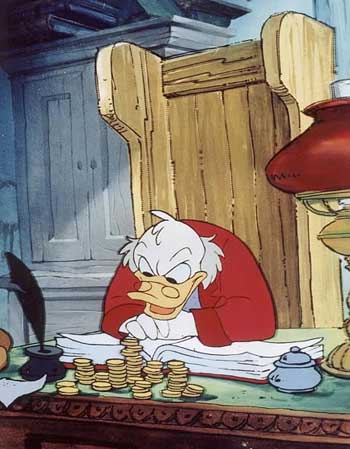
In America, where A Christmas Carol is equally - perhaps even more - beloved, Dickens' stony-hearted skinflint was portrayed or radio, for many years, by Lionel Barrymore and Orson Welles and on other occasions and in a variety of media by Basil Rathbone, Frederick March, Walter Matthau, Kelsey Grammer, Mr Magoo and Donald Duck's penny-pinching uncle, Scrooge McDuck!


From the outset, dramatists have tinkered with the original text: from small embellishments such as giving Scrooge's nephew, Fred, the surname 'Freeheart', to the invention of a sinister character called 'Dark Sam' who added to the Cratchit family's problems by stealing Bob's scant wages. One particularly free dramatization, Old Scrooge, staged in 1877, ended by reuniting the reformed miser with his lost love, Belle, who conveniently turns out to be Fred's wife's widowed mother!

Some of the more bizarre curiosities - Vanessa Williams as self-centered pop-star, Ebony Scrooge; Jack Palance as Ebenezer, a Western card-cheat and gunfighter; or Bill Murray as Frank Cross, the cynical TV executive who gets Scrooged - serve to indicate the extent to which Dickens' story has become part of popular mythology, a folk tale or fairy story which is perennially retold and reworked in the telling.


So well do we know - and love - Dickens' story that it's characters have had several sequels written about them with several amusing speculations on what might have happened if Ebenezer Scrooge had subsequently relented of his Christmas conversion and had gone back to his old miserly ways and some alarming accounts of how the angelic Tiny Tim might have turned out not so virtuous when he grew up and inherited Scrooge's business! Why, there is even a Jewish spoof on the story entitled Hanukkah, Schmanukkah!

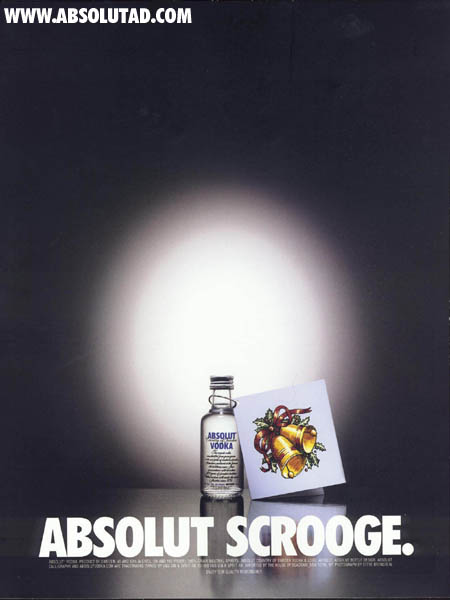
Dickens' characters have been employed by several generations of political cartoonists from Punch's John Tenniel, who depicted Prime Minister William Gladstone as Scrooge, to Gerald Scarfe who drew the Ghost of Margaret Thatcher haunting a terrified John Major. They have also found their way into various advertising campaigns for, among other products, Hamlet cigars, Heineken lager and Absolut vodka.


In fact, so well known is A Christmas Carol that even people who have never read it, actually believe they have! Say the word “Humbug!” and someone will think of Ebenezer Scrooge; utter the phrase: “God bless us, every one!” and people at once recall the words of Tiny Tim.

Small wonder that William Makepeace Thackeray, reviewing the book in 1843, wrote: “It seems to me a national benefit, and to every man and woman who reads it a personal kindness.”

One hundred and sixty-three years on, there seems no reason to quibble with that verdict.

Tuesday, November 18, 2008

"AN HONEST BOOK..."

"For every honest reader," wrote Kenneth Grahame, "there exist some half-dozen honest books, which he re-reads at regular intervals of six months or thereabouts. Whatever the demands on him, however alarming the arrears that gibber and grin in menacing row, for these he somehow generally manages to find time..."

And the man who wrote those words, himself wrote one of those 'honest books' to which 'honest readers' (like myself and many others) return again and again, and which this year celebrated the 100th anniversary its publication - The Wind in the Willows...

This book is, actually, less of a book and more of a friend - a good friend with whom you simply must keep in touch, whose company always makes you feel a little more content with life, a tad more safe in uncertain times.

For me that friendship began when I was nine years old and my parents gave me a thin, pocket-sized edition with small print and none of those wonderful E H Shepard pictures that were not the first, but certainly the definitive illustrations. In fact, the only decoration to my copy was a line drawing - stamped on the pale green cover - of two gnarled willow trees bending in the wind.

Nevertheless, as an only, sickly child, I read the book in one day and claimed the characters - gentle-natured Mole, good-hearted Ratty, no-nonsense Badger and the one-and-only, never-to be-forgotten, utterly outrageous, Mr Toad - for an extended family.

I fell under the the spell of the chattering, babbling river so beloved of the Water Rat: "It's my world, and I don't want any other. What is it hasn't got is not worth having, and what it doesn't know is not worth knowing..."

And, of course, I was captivated by the roar and rattle of Toad's errant motor car as it thundered down the open, dusty, highway ever in search of someplace new: "Here to-day - in next week to-morrow! Villages skipped, towns and cities jumped - always somebody else's horizon! O bliss! O poop-poop! O my! O my!"

The Wind in the Willows became one of the best-loved books on my childhood bookshelf. Some of the volumes that stood alongside it in those far off days have long been discarded and forgotten; others are still respected, still capable of evoking affectionate memories, but now seldom read. The Wind in the Willows, on the other hand, has remained a constant companion across the changing years.

So what was it about the book that captured my youthful imagination and still captures the fancy of the older, more worldly-wise adult? What I adored, when young, was Kenneth Grahame's ability to spin a yarn full of lovable characters and comic escapades: Toad the daredevil adventurer, stealing cars, escaping from gaol, commandeering railway engines.

What intrigues me now is the daring with which the storyteller interweaves the fun and frolic with episodes of rare and mysterious beauty: Mole yearning for his little, abandoned home; Rat listening to tales of the wide world from an old seafaring rat and the mystical encounter with the great god Pan in that curious chapter entitled 'The Piper at the Gates of Dawn'.


The resulting mix oughtn't to work - indeed when the book was first published, a lot of very grown-up people (critics and the like) said that it didn't work. The humorous magazine Punch (with singular lack of humour) described it as "a sort of irresponsible holiday story in which the chief characters are woodland animals, who are represented as enjoying most of the advantages of civilization."

Even more glorious is the pompous pronouncement in The Times Literary Supplement that "as a contribution to natural history the work is negligible" before going on to point out that a water rat would "never use a boat to navigate a stream" and pondered on the subject of a mole doing whitewashing: "no doubt moles like their abodes to be clean; but whitewashing? Are we very stupid or is this joke really inferior?"

The answer to which, of course - we now know - is obvious: yes, the critic of the TLS was indeed very stupid!

Young readers, of course, knew better: they made the book their own and then persuaded the adults to change their minds. As Grahame wrote, years afterwards: "It is the special charm of the child's point of view, that the dual nature of these characters does not present the slightest difficulty to them. It is only the old fogies who are apt to begin 'Well, but...' and so on. To the child it is all entirely natural and as it should be."

And - child or adult - we will return again and again to this miraculous book because woven through its entire length is an overwhelmingly reassuring sense of security and cosiness: of summer picnics on the river bank, walks across country fields in the frosty air of winter and afternoon tea snuggled around the fire...

Like the ancient willow trees that grow along the banks of the Thames and which gave the book its title, The Wind in the Willows has a time-enduring quality: it remains one of the most haunting evocative, boisterously funny and endlessly enchanting book ever written...

And if my recommendation won't suffice, let me leave you with the words of another admirer of The Wind in the Willows - and the man who dramatised the book and made it into what was, for many years, one of London' annual theatrical treat, Toad of Toad Hall - A A Milne:

For the last ten or twelve years I have been recommending it. Usually I speak about at my first meeting with a stranger. It is my opening remark, just as yours is something futile about the weather. If I don't get it in at the beginning, I squeeze it in at the end. The stranger has got to have it sometime.

Should I ever find myself in the dock, and one never knows, my answer to the question whether I have anything to say would be, 'Well, my lord, if I might just recommend a book to the jury before leaving...'


Happy Birthday,
Toady, Ratty, Moley and Badger!

And may you live for at least another hundred years!

Images: © Estate of Ernest H Shepard


Friday, October 17, 2008

PAULINE BAYNES: QUEEN OF NARNIA AND MIDDLE-EARTH

Pauline Baynes
(1922-2008)


This tribute, originally posted on Brian Sibley: the blog, was written a few days after Pauline Baynes' death, on 1 August 2008, at the cottage in Dockenfield, Surrey, where she had lived and worked for many years.

There are certain illustrators whose work is so intimately interwoven with the author's text as to rank as the books' co-creators. Sir John Tenniel, for example, the first illustrator of Alice's Adventures in Wonderland and E H Shepard who, with A A Milne, led us into the world of Winnie-the-Pooh. Similarly, Pauline Baynes' pictures of country and denizens in C S Lewis' seven Chronicles of Narnia are still - despite the recent big-screen movie imagery - the definitive depiction of that extraordinary land beyond the wardrobe...

I can remember, precisely, where I was when I read each of the Narnian Chronicles: for example, I read The Magician's Nephew one winter's day curled up before an open fire while my mother was making cakes and pastry on the kitchen table.

Once glance at the vista on the jacket of the Puffin paperback edition of that book still not only evokes what is, for me, the essence of the land of Narnia - with its seashore, mountains, woods and lakes - but also gives me back a specific day from the tenth year of my life!


I first met Pauline almost thirty years ago, in October 1979, at a 'Narnia Book Fair' held at Church House Bookshop, Westminster. I was carrying one of my most treasured possessions: a copy of Tolkien's The Adventures of Tom Bombadil which the author had signed for me ten years earlier. She added her own signature to the title page, doubling its value to me as a collector.


Following that initial meeting, we kept in touch, collaborated on a book, The Land of Narnia, and, during the past 10 years, became close friends.

After the death of my and David's mothers, she became a kind of adoptive mum and (perhaps because she had no children of her own) interested herself in what we were doing and fussed over and cared for us in the various ups and downs of our lives. We loved her dearly and are deeply aware of how we - and others in her extended adopted family - are going to miss her...

She had a ceaselessly inquiring mind and energetically debated every topic imaginable. She could be sharply critical and quixotically changeable; she never suffered fools gladly, sniffed out cant and hypocrisy in a second and enjoyed nothing better than the kind of conversation which could veer from total seriousness to helpless laughter.

But all these are personal feelings and what I want to do in this posting is remind people of the extraordinary talent possessed by this modest, unassuming woman who created images that define the childhoods of millions...

After producing illustrations for various books of fairy tales, Pauline Baynes' career was established when, in 1949, J R R Tolkien's publishers showed the author of The Hobbit a portfolio of her artwork. Tolkien had written Farmer Giles of Ham, a fanciful novella with a faux-medieval setting, and being dissatisfied with the pictures that had been produced for the book was looking for a new illustrator.

Pauline produced a series of witty line illustrations that perfectly caught the essence of Tolkien's story to an extent that he declared them to be "more than illustrations, they are a collateral theme." He also delighted in reporting that friends had said that the pictures had reduced his text to "a commentary on the drawings"!

Pauline revisited the story of Farmer Giles and his exploits with the somewhat reluctant dragon, Chrysophylax Dives, on several occasions such as for the 50th edition of the story published in 1999...


It was the beginning of a long friendship between author and illustrator with Pauline decorating Tolkien's subsequent books, The Adventures of Tom Bombadil and Smith of Wootton Major.


It had been Tolkien's wish that Pauline should illustrate The Lord of the Rings, but the book grew into a project that rendered that plan impractical although it was her slipcase design for the three volumes that was adapted as a cover for the first one-volume paperback edition - providing what was, for an entire generation, a peek into the essentially English landscape of Middle-earth...

Click to enlarge

Posthumously Pauline illustrated Tolkien's Poems and Stories (including Leaf by Niggle) and Bilbo's Last Song. She also created that memorable map of Middle-earth that was a feature of thousands of student bedrooms...

Click to enlarge

I remember Pauline telling me that she always wondered whether Tolkien's wife, Edith, had ever actually read her husband's magnum opus. Her doubts stemmed from the day she took her artwork for the Middle-earth map to show the author. Above the map she had drawn the figures of the Nine Walkers - Frodo, Sam, Aragorn, Gandalf, Boromir, Legolas, Gimli, Merry and Pippin - setting out on the Quest of the Ring; beneath the map she had added an array of villains: marauding Orcs, the Nine Black Riders, Gollum and, the bottom right hand corner, Shelob.

Tolkien was pleased with the map - apart from one mis-spelled name that had to be corrected - and called to Edith to come and see. "Look what Pauline's done," said Tolkien. Edith scrutinized the map and the two groups of characters and then - pointing to Shelob - said: "Ooo, look at that horrid spider!"

Click to enlarge

It was the collaboration with Tolkien that resulted in Pauline's subsequent association with the septet of children's novels by C S Lewis beginning with The Lion, the Witch and the Wardrobe and known, collectively, as The Chronicles of Narnia.


"Met C S Lewis. Came home. Made rock cakes." That's how Pauline's diary recorded one of the two meetings she had with the author whose work she so memorably embellished. It tells you exactly how she viewed her contribution to books that, for millions, of us were seminal childhood reading.

The illustrations for the Lewis books contributed significantly to their success and now are inseparable from the text, but she illustrated over a hundred other books as well as designing jackets and frontispieces for others and contributing numerous decorative pictures (left) to the illustrated magazines which proliferated in the '40s and '50s such as The Sphere and The Illustrated London News.

Her artistic output was astonishing: designs for stained glass, church embroideries and Christmas cards, pictures for school text books, and fanciful advertisements for a variety of products such as, here (courtesy of her friend, Martin Springett), Huntly and Palmer's biscuits...


Among her finest works (and there are a great many more) should be listed Henri Pourrat's A Treasury of French Tales; Amabel Williams-Ellis' Fairy Tales from the British Isles and The Arabian Nights (reflecting her fascination with Persian miniatures); The Puffin Book of Nursery Rhymes, collected by her friends Peter and Iona Opie; and Grant Uden's A Dictionary of Chivalry which contained a staggering near-600 illustrations in its margins and won the artist the coveted Kate Greenaway Medal.

She illustrated stories by Rosemary Harris, Rumer Godden and Helen Piers as well as the final volume of Mary Norton's Borrowers saga and produced another iconic images for the cover of the first paperback edition (right) of Richard Adams' Watership Down.

What her work on these and other books show is her tirelessly painstaking research into the detailing of period costume and architecture and, above all, her extraordinary talent for conveying landscape and depicting natural life - especially animals, whether wild or domestic and, in particular, horses and, of course, dogs which were so much a part of her life.

Her later picture books - many on religious subjects - such as All Things Bright and Beautiful, The Song of the Three Holy Children, Noah and the Ark and In the Beginning, demonstrate the artist's talent for design and her superb mastery of fluid line, gem-like colours and the use of negative space.

There were also an amazing number of drawings done as favours for friends. For example, in 1977 I was editing Bandersnatch, the newsletter of the Lewis Carroll Society when the discovery of the 'lost' chapter of Through the Looking Glass and what Alice Found There, featuring a Wasp in a Wig reading a newspaper came to light.

The episode had been dropped from the book at proof stage because John Tenniel had said such a bizarre character was beyond his powers to illustrate. But Pauline proved Tenniel wrong by creating this superb miniature (left) which I featured on the mast-head to Bandersnatch for several years.

Pauline remained prolific until the end of her life, illustrating a selection of writings from the Qur'an and the Book of Job (below) which are still to be published...

Click to enlarge

One of Pauline's last completed projects was producing 22 full page illustrations for a story of mine, entitled Oscar the Extraordinary Owl. She was disappointed when a succession of publishers declined the book, and concluded that her style was now too old fashioned and out of step with the current trends in children's publishing.

Click to enlarge

Click to enlarge

One day, I trust, someone will recognise again her singular talent for composition and publish some of these works which she made towards the end of her life purely for the pleasure of making pictures - so that they may bring pleasure to others just as her illustrations to the books of Lewis and Tolkien have done for fifty years...

When we visited her a few weeks ago, the drawing board facing in the window that looked out onto her pretty cottage garden, was covered with a series of energetic illustrations - each a mini-masterpiece of design - illustrating Aesop's Fables (right).

Today, that drawing board lies bare.

The artist is gone; but the artwork that she created lives on...


You can read my full obituary to Pauline Baynes here in The Independent.

Other obituaries appeared in The Guardian and The Telegraph; although unsigned they were written by two more of her close friends, respectively, David Henshall and Charlotte Cory. There was also a full obituary in The Times.

Monday, May 05, 2008

POPPIN' UP

A curious decision, I thought: to cut virtually all references to Julie Andrews from my recent book (with Michael Lassell) Mary Poppins: Anything Can Happen If You Let It. After all, it was the film that made our Julie a movie star...

But there was no discussion about the matter - my paragraphs on Julie's casting in what was the crowning masterpiece of Walt Disney's career, together with her personal recollections of Disney and Poppins' creator, P L Travers - simply had to go.

Frankly, I thought this rather odd, especially since the Andrews quotes had come from an interview which she had given me when I was making a BBC radio series called Disney's Women and had already appeared - with Ms Andrews permission (or, at least, so I understood) - in 'How Are They Going to Make That into a Musical?', an essay I contributed to A Lively Oracle: A Centennial Celebration of P L Travers, published in 1999.

Then, why? Well, I can only surmise that it was because Ms Andrews was about to publish the first volume of her autobiography, autobiography, Home: A Memoir of My Early Years, and didn't want any 'spoilers' appearing ahead of time.

Anyway, since the book is now published, it's probably safe to reveal that expurgated text.

So, here it is...
It was Walt's secretary, Tommie Wilck, who suggested Julie Andrews, the young British singer who had achieved stage stardom in London and New York as Eliza Doolittle in My Fair Lady, and who was currently appearing on Broadway as Queen Guinevere in the musical, Camelot.

Towards the end of 1961, returning from a visit to Europe, Walt stopped off in New York to see a performance of the Arthurian romance. As Julie Andrews sang, danced and whistled her way through the show stopping number 'What Do the Simple Folk Do?', Walt was convinced that he had found his Mary Poppins.

Backstage, after the show, Walt talked enthusiastically about his plans for the film. “There was no preamble,” Julie recalls, “he said he’d loved the evening and he wanted to talk to me about a project he had in mind for the film of Mary Poppins. I said, ‘Well that sounds lovely’. I don’t remember having had doubts other than ‘Can I make a movie?’ This would be my very first picture and as much as I’d always wanted to go into film I thought, ‘Gosh, would I be able to do it justice? Would I be any good at it?’ and so on.”

However, Walt was persistent and Julie agreed that, once Camelot had ended its run, she would visit the Disney studio with her then husband, designer Tony Walton. Meanwhile, she read the books and began to have doubts not just about her own ability but also about the possibility of adapting the source material for the screen.

“The books were so perfectly written,” she recalled, “but they were so boxed-in with their primness and rigid discipline that I thought ‘Now, how are they going to make that into a musical?’ And, of course, it was miraculous the way that they did.”

Any lingering anxieties were dispelled when she and Tony Walton arrived in Burbank at what Hollywood referred to as ‘The Mouse Factory’: “The minute I walked into the studio and saw what Walt had prepared, I could tell that Poppins had something special about it.”

Looking at the storyboards and hearing the songs convinced Julie that she should accept the role: “The thing that was wonderfully appealing was that my background, long before I had been on Broadway, was vaudeville and music-hall. And the songs they played me on that first day, were wonderfully reminiscent. They had that knock-down, drag-out quality of the good old vaudeville songs and I loved them!”

About one song only, Julie had reservations: it was the ballad 'The Eyes of Love' which the Sherman brothers had come to think of as Mary Poppins' theme. She, however, thought the song too sentimental and not very 'Poppinsish'. In an attempt to find an alternative, the composers drew on an experience of Robert Sherman's younger son who had recently been given an inoculation at school that had been disguised with a spoonful of sugar. The resulting song became one of the most popular in the film.

Walt hoped to clinch the deal by offering Julie $125,000 and asking Tony Walton to be the film's design consultant, but there was one lingering issue: she was still under consideration for the role of Eliza Doolittle in the screen version of the show that had made her name My Fair Lady.

Julie wished more than anything to play on film the role she had created on stage, but Walt wanted her to be Mary Poppins and was so eager for her to commit to the film, that he promised to release her from her contract if Warner Brothers offered her the part in My Fair Lady. In the event, Jack Warner decided that casting Julie was too big a box-office gamble (having Rex Harrison play Professor Higgins was even thought risky) and opted, instead, for the glamorous, but non-singing, Audrey Hepburn. Warner's loss was Disney's gain.

P L Travers had described Mary Poppins as being thin, plain and “rather like a Dutch doll”, with “large feet and hands, and small, rather peering blue eyes.” Although Julie Andrews, at twenty-seven, was considerably prettier, she skilfully captured much of Poppins’ enigmatic personality, described by the author as “a mixture of arrogance and poetry and, underlying both, a certain invincible integrity.”

Julie, who was pregnant, returned to England to give birth and, thirty-six hours after the arrival of her daughter Emma, she received a phone call in hospital: “They said, ‘There’s a Mrs Travers on the line for you,’ and I thought, ‘Oh I’d better speak to her, doesn’t anybody know that I’ve just given birth and I’m feeling a bit weary.’ And she came on, she said, ‘Hello, this is P L Travers, is this Julie Andrews? Talk to me! I want to hear what you sound like.” I said, ‘Well what can I tell you, Miss Travers, I’m very thrilled, I believe I’m going to be doing a film based on your books.’ ‘Well,’ she said, ‘you’ve got the nose for it that’s for sure; you’re too pretty, but you’ve got the nose for it.’”

Later, Julie went to afternoon tea with Pamela and still remembers her assessment of the author: “I liked her, she was an eccentric and rather tough old girl but a good hearted one I felt.” Pamela was equally responsive to Julie and - whatever her subsequent reservations about the film - was unfailing in her praise of the actress, describing her as having “integrity and a true sense of comedy” and her performance as showing that she understood “the essential quality” of Mary Poppins.
There! That's what you didn't read in the Poppins book although, in her autobiography, Julie Andrews has told the tale in her own words - which are pretty much just about the same!

Home only takes the Andrews story as far as the Walt Disney engaging her to play Mary Poppins and that curious maternity wing telephone conversation with P L Travers...

I actually wrote quite a bit more written about the filming and the Oscar-winning success of Mary Poppins, but since Ms A is at work on a second volume of autobiography, I guess I'd better - for the present - keep that to myself!

In the mean time, you may care to read my review of Home.


Friday, November 30, 2007

GRIEF-STRICKEN

I decided it was time I read David Michaelis' Schulz and Peanuts, the recently published (and arguably controversial) biography of the creator of Charlie Brown and Snoopy whose cartoon creations are not just icons of American popular culture but also internationally beloved folk characters.

The book is controversial because, according to the subject's family (who now regret having authorized the book) Michaelis has represented Charles ('Sparky') Schulz as an essentially unhappy, unfulfilled man whose lifelong sadnesses and insecurities were the basis for the cartoon strip adventures featuring the Peanuts gang.

According to Michaelis: “[Schulz] was a complicated artist who had an inner life and embedded that inner life on the page. His anxieties and fears brought him Lucy and the characters in Peanuts. A normal person couldn’t have done it.”


Authorized biographies are, frankly, dodgy territory (I know, I've written two!): the seal of approval may give the biographer access to people who might not be so willing to cooperate with an unofficial chronicler, but it also tends to encourage interviewees to speak with a openness that places a heavy burden on the writer when the time comes to decide just how much candidness to go in for!

Since the subject of his book was dead, David Michaelis went for a 'warts and all' approach, although apart from an affair at the time that his first marriage was breaking-up there aren't much in the way of skeletons in the Schulz cupboard.

In fact, part of the difficulty with the book is that Schulz' life was pretty uneventful: he did what he did consistently well for many years, but not much else happened. As a result, Michaelis is forced into trying prove that everything in the Peanuts comic strips has some source of inspiration in Schulz' life and personality which effectively reduce the artist's very real genius to little more value than a series of thinly-veiled autobiographical sketches.

The portrait that emerges is rather dour and depressing and casts a long, somewhat chilly shadow over the cosily fuzzy public perception of Schulz's world and its 'Happiness is a Warm Puppy' philosophy.

Suddenly those episodes in which Charlie Brown fails to fly a kite or kick the football or summon up the courage to speak to the Little Red-Haired Girl are seen as Schulz grappling with bitter angst-ridden memories or exorcising ugly personal demons. In consequence, the reader finds many fondly remembered Peanuts episodes raising less of a smile than a shudder.

Click image to enlarge

I corresponded briefly with Schulz and wrote his obituary for The Times when he died, but I never met him and have no idea if he truly was the Mr Misery that emerges from Michaelis' sombre and - bizarrely for a work devoted to the work of a humorist - singularly humorless book.

I do know, however, that Schulz won the admiration of other professional cartoonists for a career spanning almost 50 years in which he single-handedly wrote and drew 17, 897 strips. One has only to look at dozens the tribute cartoons that were drawn by America's leading artists when Schulz put down his pen for the last time in 2000 to see the esteem in which he was held...


This is just one of many examples.

I also know - as do millions of others - that Schulz made us LAUGH: at Charlie Brown's unfailing stoicism, at Linus' philosophical astuteness, at Lucy's innate crabbiness, at Peppermint Patty's infallible optimism and, above all, at Snoopy's irrepressible joie de vivre: whether in doing the obvious doggy things including making it patently clear when it was SUPPER TIME or indulging in less usual canine activities such as dancing, skating, performing a puppet version of War and Peace on top of his dog-house, donning flying helmet and goggles in order to tackle the cursed Red Baron or sitting at the typewriter and pounding out a new magnum opus...

Click image to enlarge

David Michaelis' book may be the authorised word on Schulz, but it's unlikely to the the last word...


Images: © Charles Schulz

Saturday, November 03, 2007

GIRLS WILL BE GIRLS

One of top best-sellers last Christmas for those seeking something to go into the stocking of men of a certain age was Tom Cutler's 211 Things a Bright Boy Can Do.

This excellent manual was packed with useless facts and useful fun of the kind we have been so cruelly deprived of since the demise of those bumper books of things to try - and usually fail! - to make-and-do that proliferated in the days of our youth...

Well, a year has now rolled by and the season of present-buying looms once more, so it is good to see that, spurred on by Tom Cutler's efforts, Bunty Cutler (who is not Tom's formally estranged twin-sister) has published a companion volume: 211 Things a Bright Girl Can Do.

I can do no better than invite my sister, BRENDA SIBLEY, to review this worthy tome...


Arguably, of course, this ought to have been called 212 Things a Bright Girl Can Do, since everyone knows that any girl is bright enough to think of at least one thing (and usually a great many more) than even the brightest boy is capable of coming up with...

Howsoever, I have huge respect for the labours of Ms Cutler, whom I remember with giddy schoolgirl affection from my days in the Chalet School when she was our revered Vice-Captain.

No one, I can assure you, was better suited to that particular post than Bunty as, indeed, is ably shown by the contents of the concluding section of her book -- How to Be Bad: All you need to know to be a very naughty girl -- which contains such invaluable wrinkles as
'How to slide down a fireman's pole' (this is hot stuff, I tell you!), 'Complete whipcaft' (ah, the memories!), 'How to hide a file in a perfect Victoria sponge' (which I could certainly have done with knowing back in those days when I was dating Reggie - or was it Ronnie? - Kray) and 'How to strangle a man with your bare thighs' (which ditto) a procedure which can be accomplished in 11 easy stages although, as Bunty sagely advises, "better practise a bit first on a friend."

Lest anyone run a away with the idea that Bunty Cutler's book is solely devoted to such sensational topics - although, girls, I would personally recommend that you read page 233 ('How to pull off a man's shirt in a twinkling') before accepting any Christmas party invitations where 'turns' might be called for - there are oodles of really useful and truly indispensable KNOWLEDGE with a capital 'K'... Well, actually, as you can see, I used all capitals!

The book contains sections on cuisine (when haven't we all wanted to know 'How to make yogurt in a thermos flask'?), home-making (this Christmas many of my friends will be receiving my efforts after reading up on 'How to make a Mateus Rosé shell lamp'); hostess-craft which embraces all manner of sound advice for she with ambitions to be the "mostest", ranging from 'How to descend a staircase in high heels' and
(on a related problem) 'How to dance with a man shorter than yourself', plus discreet information on 'How to fart with grace and charm at the ambassador's do' which, again, brings back memories of the aftermath of those midnight feasts in dorm 3B at Chalet School!

The section How to be Completely Gorgeous is, naturally, a must for busy girls and the regime for losing six pounds in six hours is a miracle of determined thinking, while 'How to make a little black dress out of a bin liner' could be a life-saver for many -- though do, please, observe Bunty's warning not to iron!

Powder-Puff Mechanics will help you escape a vicious swarm of bees ("cover your face with whatever you have to hand - not golden syrup or Ribena, obviously..."), get rid of a spider from the bath, meet your ex's new girlfriend (always a test of a bright girl's stamina) and 'How to pack for a holiday without using more than five large suitcases': essential reading for
Victoria Beckham and, incidentally, my brother, Brian!

Bunty Cutler was always a whiz at games, so I knew that I could implicity trust the advice in the section amusingly entitled Jolly Hockysticks! which not only gives full instructions (with diagrams) on how to do a cartwheel, jump hopscotch and water-ski but will also save you acres of potential embarrassment at house parties by telling you 'How to throw overarm'!

More in the vein of hobbies than sports, there's all that you need to know about reading tea-leaves and identifying British wildflowers and - though it is scarcely anyone's pastime of choice - no fewer than 12 helpful hints on 'How to worm a cat', such as:
"Wrap cat in large bath towel, head just visible. Ask man to lie on cat and put pill in drinking straw. Force cat's mouth open with pencil and blow pill down cat's throat." Why, oh why, has no one put it quite so simply before?

So, my verdict on Bunty's
book? Absolutely topping: whether you are wanting to know how to make 'Flapjacks without fuss' or 'How to get out of a car without flashing your knickers', this is the book for you. As for me, I'm off to revise what I've learned from Bunty's comprehensive guide to 'Belly Dancing for the Complete Novice', after which I really must brush up on the old whipcraft... Altogether now: "Oh! The Deadwood Stage is a-headin' over the hills!"


Thanks, Brenda! And Bunty's book 211 Things a Bright Girl Can Do, published by HarperCollins at £10.99 is available from all good (and probably quite a few mediocre) bookshops or you can order copies of on-line together with (for any boys who missed out) the original male-designated volume as a double whammy from Amazon!

Signed Books: 2 – JOURNEY'S END

Among my collection of signed books are volumes given to me by writers who were also friends along with others by writers, actors and celebr...