Wednesday, October 31, 2007

LOOK-SEE

Hands up everyone who remembers Look and Learn?

I must begin by explaining my passion: every week, from the age of 8 or 9, I received a copy of The Children's Newspaper (on my parents insistence - as an antidote to my comic of choice: Walt Disney's Mickey Mouse Weekly) and although TCN was crammed with articles and features of, as they say, 'interest'; it was, frankly, all a bit worthy.

I suppose I must have read four or five year's-worth of editions of TCN, but can't now recall to mind a single story or image! And yet I can conjour page after page of the Look and Learns that I used to pore over in the school library from its first magical appearance in January 1962.

Every now and again I'd poke my nose into a copy of Knowledge which were also in the library, but I always thought this rival publication, launched a year earlier than L&L, was really a bit on the stuffy side - certainly in comparison with L&L which was a magazine that lived up to its stated aim of providing "a treasure house of exciting articles, stories and pictures" and which positively exploded with vibrant, dynamic illustrations that grabbed the eye and hooked the imagination!


Click on images to enlarge

L&L had the all visual appeal of the comic but with a content - incredibly diverse, sometimes astonishing esoteric - that won the approval of educators and, most importantly, mums and dads!

Small wonder it launched with sales of a million copies and eventually settled down to a highly respectable 300,000 copies a week and, two years after its fist appearance of the news-stands, took over the aforementioned The Children's Newspaper.

Look at what was shoe-horned into the 24 pages of the first issue --- and all for the outlay of just ONE SHILLING:
A photograph of the young Prince of Wales, Charles, dominated the first cover, alongside a painting of the first Charles, Prince of Wales from 300 years earlier...

Elsewhere in this first issue, colour photographs and colour illustrations helped tell the history of Rome and reveal the wonders of nature; you could learn about Vincent van Gogh, the Grand Canyon, how Japanese children celebrated the festival of Shichi go san or how to keep a Basset hound.

Other articles probed the depths of space for life amongst the stars and below the ground for oil; the story of Parliament was magnificently illustrated across the centre pages; equally superb was the first leg of a trip exploring the history of towns and villages along the road from London to Dover; and for those readers who enjoyed stories as well as history, nature, science and art, there was a feature on Sindbad and the famous author and explorer who had translated his adventures plus the opening chapters of The Children’s Crusade by Henry Treece, and Jerome K Jerome’s famous Three Men in a Boat.

- Steve Holland, Archivist, Look and Learn
During its twenty-years and over 1000 issues, the role call of talent working on L&L - though, as kids we didn't know it - was impressive to say the least: historians Leonard Cottrell, John Prebble, Robert Erskine and Alfred Duggan; novelist and traveller Bruce Graeme; zoologist Maurice Burton and naturalist Maxwell Knight; and, yet to establish his career as an award-winning novelist, Michael Moorcock.

The artists represented the cream of the book illustration at the time and included such graphic artists - to name but a few - as Peter Jackson, C L Doughty, Ron Embleton, Don Lawrence, Angus McBride, Jesus Blasco and (below) Oliver Frey... .


Every single issue lived up to its title: we looked and we learned --- about so many things... About the natural world as it is and, as very dinosaur-loving kid knew, it once was...


About the lives and careers of statesmen, scientists and explorers...


About countries, cities and buildings...


About triumphant deeds and tragic events...


There were all manner of excitements and amazements: from flights of fancy...


To modern-day realities...


And future possibilities...


As well as, again and again, all those enticing windows into some of the greatest books, plays and poetry of the world: some of which I already knew and loved and others that, thanks to L&L, I went on to discover...


I probably skipped launch-editor David Stone's editorial description of L&L when, as thirteen year old I was excitedly racing through its colour-filled pages, but it seems to me, now, to pretty much sum up what the magazine was to its devoted readers:
Look and Learn is not a comic, or a dusty old encyclopaedia pretending to be an entertaining weekly paper. It is really like one of those fabulous caravans that used to set off to strange and unknown places and return laden with all sorts of wonderful things. In our pages is all the excitement, the wonder, the tragedy and the heroism of the magnificent age we live in, and of the ages which make up the traditions which shape all our lives.
I can't overstate the influence of L&L on my formative years - it bred in me an inquisitive fascination with facts, words and books which still lingers to this day and, I think, even informs some of the topics that turn up on this daily blog!

And now - joy of joys - there's a newly published Bumper Book of Look and Learn and 24- or 48-issue serial publications of the best of the original Look and Learns, "printed to have the same look and feel as the original..."

Full details can be found on the Look and Learn web-site which is as jam-packed with stuff as the original mag and where you can also read the full, fascinating history of the magazine and - fabulous time-waster this - browse the picture library of 19,073 images which can be downloaded or sent as e-cards...

So quit this page and start wallowing in a bit of pure, unadulterated nostalgia; and - look! - you never know, you might actually learn something!


Images: © 2007 Look and Learn

Saturday, October 27, 2007

A DEATH IS ANNOUNCED

Robert Alton Harris wrote:

You can be a king or a street sweeper,
But everybody dances with the Grim Reaper.


This reminded me of an exchange I once had with Discworld author, TERRY PRATCHETT, during an interview for a BBC book programme.

We were talking about DEATH, who appears as a character in many of the Discworld novels and who - contrary to expectations - has a butler (Albert), an adopted daughter (Ysabell), an assistant (Mort), a pale horse (Binky) and lives in a black-and-white, suburban villa with a golf course and a pond containing a skeletal trout!

"Just supposing," I said to Pratchett, "that the door to this studio was to suddenly whisper open and DEATH was to come in and lay his bony hand on your shoulder, what would you do?"

"Well," replied Pratchett, "there's nothing I could do! But that wouldn't matter, because I long ago learned to take life as it comes!"

He paused and then, with a wry smile, added: "Which, of course, when you think about it, is exactly what DEATH does: takes life as it comes!"

Wednesday, July 04, 2007

MEMORIES OF MOOMINLAND

What is a Moomin? You could say it is something like a small white hippo but with a bit more tail, but it really doesn’t get you very far…

Basically, when it comes to Moomins, you’re either a Moomin person or you’re not…

Some months ago, while snooping round one of numerous blog-sites of animator and illustrator Elliot Cowan, I realised that he was a Moomin person. I knew this the moment I came across a haunting little drawing entitled ‘Tove Tribute’…


Then, this week, Elliot posted a blog, More Tove…

So, what is a Tove? Well, like Moomins, you either know or you don’t…

There are, of course, toves (of the "slithy" variety) referred to in the poem 'Jabberwocky', but Tove - in connection with Moomins - is Tove Jansson (1914-2001), the Finnish artist and writer who wrote in Swedish and whose name, as she told me in a letter once, was Norwegian: “The first Tove, a princess, is said to have been buried in a sea shell. In Hebrew, ‘Tove’ means ‘good’.”

Any Moomin fan will think both those linguistic associations are appropriate to the woman who created the Finn Family Moomintroll: Moominpapa, Moominmama and their son Moomintroll...


And Moomintroll's friends Snufkin and Sniff, the Snork and the Snork Maiden, the Muskrat, Tooticky, Ninny, Mimble and Little My, assorted Hemulens and Thingumy and Bob...


Not to mention the terrifying Groke and the spooky Hattifatteners --- seen here in 3-D form as presented to me by my good friend and fellow Moomin-fan, Emma!


I first met the Moomins in 1954 in the daily comic strips written and drawn by Tove Jansson, which appeared in the Evening News that my Dad used to bring home from work each night.


Tove’s brother, Lars took over the strips in 1961, in which year, Puffin Books (God bless ‘em!) published the first paperback edition of Tove’s novel, Finn Family Moomintroll translated from the original Swedish. This was followed by, among others, Comet in Moominland, Moominsummer Madness, Moominland Midwinter and Tales from Moominvalley. Eight novels in all, plus various delicious picture books…


What captivated me about the chronicles of Moominland was the combination of fantastical storytelling with exquisite black-and-white illustrations that evoked feelings of warmth, happiness and security, shadowed by a hint of sadness, longing and regret, and tinged with a kind of yearning that is both nostalgic and elegiac.

In Moominvalley, everyone - however curious or odd: an invisible child or a cross-dressing Hemulen - was welcomed and accommodated somewhere in the tall, tower-like Moomin House.

It is tolerant world in which love is unconditionally guaranteed and where every individual is allowed - encouraged - to be themselves without criticism or censure; a world where home is the safe, centered heartbeat of life to which the inhabitants always return but from which they are also free to set off on adventurous quests in search of whatever might lie over this mountain or beyond that sea…


I always wanted to write to Tove as a youngster, but to a child of the ‘50s, Finland might as well have been on the moon; and, indeed, Tove (with her life partner, the artist Tuulikki Pietilä), lived on a small island called Klovharu, that, in the days before instant global communications, was about as remote as you could wish an island to be.

Although I never wrote that fan-letter, I loyally maintained my love of Moominvalley into adolescence and beyond, by which time I had found her beautiful adult novel about childhood and old age, The Summer Book, which has recently been republished along with a companion volume of stories, The Winter Book, and one of Tove's novels, Fair Play, all of them accompanied by considerable contemporary hoop-la in the form of endorsements from the likes of Esther Freud, Ali Smith and Philip Pullman.

Anyway, twenty years after first falling in love with the Moomins, I finally decided to attempt to make contact with Tove.

In the meantime, I had discovered that she had also illustrated Alice’s Adventures in Wonderland and, at the time, I was working a book (that has never seen the light of day) about interpretations of Lewis Carroll’s story in the popular media.


So it was that, in 1975 we began a correspondence that ran, on and off, until 1995, during which time, we exchanged letters and cards and Tove sent me several books and a hand-drawn greeting that is now one of my most treasured treasures…


Tove wrote to me at length about Hans Andersen and Lewis Carroll (she had also illustrated The Hunting of the Snark) and talked about how, as a child, she had initially disliked the Alice books:
Reconstructing afterwards is difficult, one is afraid not to be honest, but I believe that I felt Carroll’s anguish and reacted by fright.

Of course, I read Alice again, 20, maybe 30 years later, still without knowing anything about Lewis Carroll’s life - and I was fascinated, enchanted. Most of all by his unbelievable capacity of [sic] changing everyday reality into another underground-reality, more real, overwhelmingly so - one dives into the depths and stays there until the end. It is nightmarish.


As far back as I can remember, I have had nightmares, maybe that was why I couldn’t like Lewis Carroll as a child. In 1966, when I illustrated the Swedish translation of Alice in Wonderland, I read about his life, and understood…
Being at the time a relatively successful broadcaster with a string of BBC radio profiles of children’s writers to my credit, I made several attempts to make a feature about Tove and her world.

She eluded me for years and then, when she finally turned 80 and was far from well, she wrote to say that she had at last reached an age where she could now be excused a process which she had “disliked and feared” as long as she could remember. “Now it’s final,” she said, “and a great relief.” She signed off saying, “Hope you understand. Have a fine winter…”

Of course I understood, but the disappointment was sharp and still smarts.

In our correspondence I had told her - many times over, I imagine - how much and why I loved her work, but, too late I realised that there was still so many other things that I longed to ask her...

Had I managed to find my way to her and Tuulikki Pietilä's little house on Klovharu, I should have liked to ask her thoughts on Tolkien since she had illustrated The Hobbit but, like her drawings for The Snark, it has never been published outside Sweden. And I would have asked about her extraordinary understanding of youth and age; about the sense of longing and loss that runs through her books; and, most of all, about her acutely-felt perceptions of love, parenthood and friendship.

Then, if we had reached that far in the conversation, I might even have had the courage to ask her perceptions on same-sex relationships…

Well, alas, that was not to be, but in her letters she at least revealed some insights into the mysteries of creativity.


So, for Elliot (whose been nagging me for ages to write about Tove) and other Moomin fans, here are just a couple of thoughts from the Mistress of Moominland…
It is so very difficult to know in what degree one’s work has been influenced… How can I know when I portrait [sic] my own anguish, or dreams, or memories - or somebody else’s? There [are] constant influences… a lot of them maybe part of the big addition ending up in, say, writing or drawing…

Whatever they may be, they are possibly drowned in the everlasting stream of impressions where one never knows what is one’s own and what is a gift from outside…

[Photo of Tove by her brother, Per Olof Jansson]

Sunday, December 10, 2006

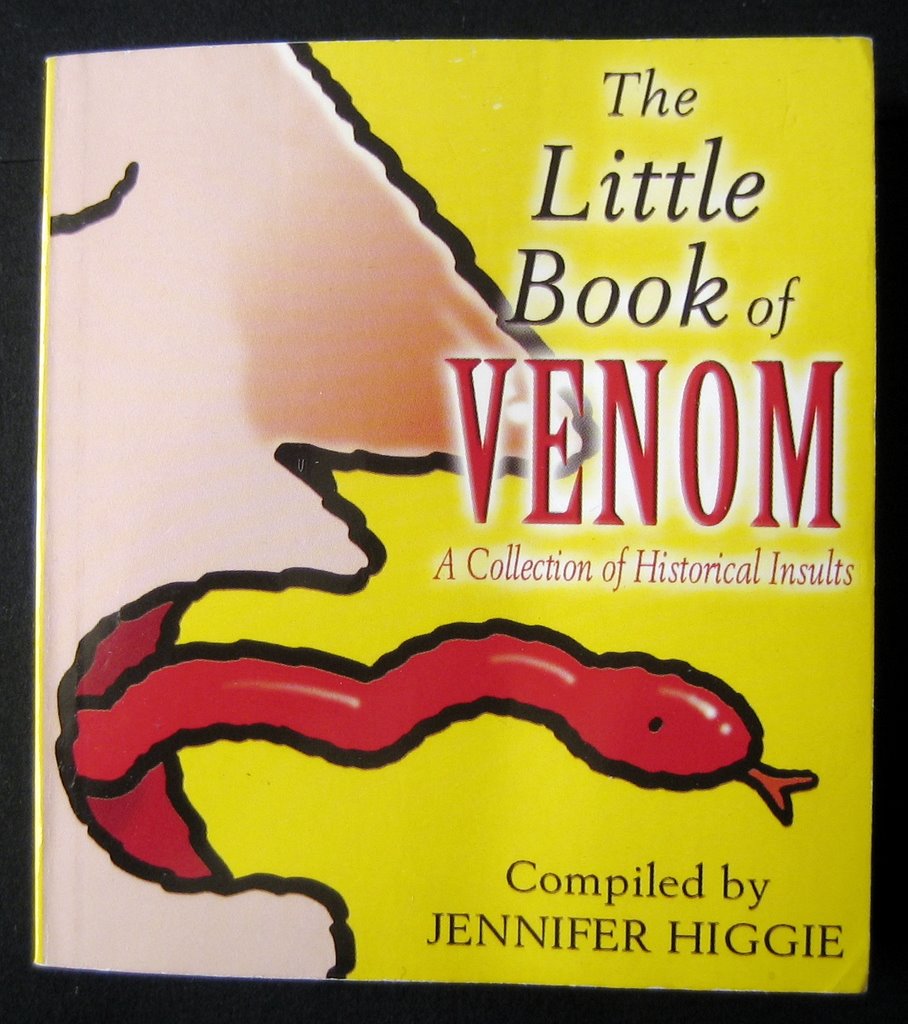
The LITTLE BOOK of VENOM

With permission, I should like to share with you a few cyanide-scented sentiments and arsenic-flavoured accolades from another of my loo-side treasuries - The Little Book of Venom: A Collection of Historical Insults compiled by Jennifer Heggie

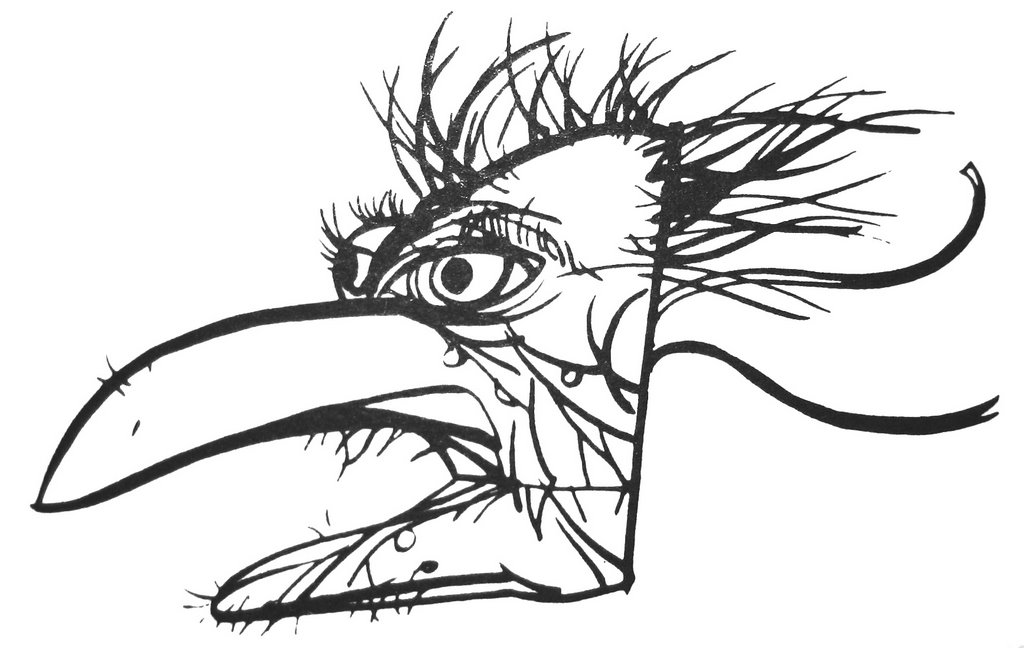
A quite excellent nosegay of nastiness, this innocent-looking little collection is one in which musicians are murdered...

Bernard Levin on the music of Frederick Delius: "The musical equivalent of blancmange"

Oscar Wilde on Richard Wagner: "I like Wagner's music better than any other music. It is so loud that one can talk the whole time without people hearing what one says. That is a great advantage."

...politicians are pulverised...

Benjamin Disraeli on Robert Peel: "His smile is like the silver fittings on a coffin."

Aneurin Bevan on Clement Atlee: "He brings to the fierce struggle of politics the tepid enthusiasm of a lazy summer afternoon at a cricket match."

...historical figures are hammered...

Charles Dickens on Henry VIII: "The plain truth is that he was the most intolerable ruffian, a disgrace to human nature, and a blot of blood and grease upon the history of England."

George Bernard Shaw on Queen Victoria: "Nowadays, a parlour maid as ignorant as Queen Victoria was when she came to the throne would be classed as mentally defective."

...playwrights are poleaxed...

H G Wells on George Bernard Shaw: "An idiot child screaming in a hospital."

Queen Victoria on William Shakespeare's King Lear: "A strange, horrible business, but I suppose good enough for Shakespeare's day."

...divas are destroyed...

W B Yeats on Mrs Patrick Campbell: "An ego like a raging tooth."

George Bernard Shaw (again) on Isadora Duncan: "A woman whose face looked as if it had been made of sugar and someone had licked it."

...and authors are assassinated...

Lord Byron on John Keats: "A tadpole of the lakes."

Dame Edith Sitwell on Virginia Woolf: "Virginia Wolf's writings is no more than glamorous knitting. I believe she must have a pattern somewhere."

Finally, here's an all-purpose Arab curse that is seriously worth committing to memory for daily use in any stressful situation: "May your left ear wither and fall into your right pocket."


The Little Book of Venom: A Collection of Historical Insults, compiled by Jennifer Heggie in 1999, is published by Michael O'Mara Books Ltd.

Saturday, November 25, 2006

The HALLOWEEN TREE

Every October in the weeks leading up to Halloween grimacing skeletons and gap-toothed pumpkin-heads seem to proliferate everywhere…

In only a few years, Halloween in this country has gone from being a totally American and utterly un-British (and therefore inexplicable) holiday to being up there in the UK marketing and merchandising league with Christmas, Easter and Valentine’s Day.

There was a time when the only glimpse those of us on this side of the Atlantic ever got of the trick-or-treat world of Halloween was in Charles Schulz’ annual Peanuts strips in which Linus vainly waited in the pumpkin patch for the arrival of his own mythical invention, the Great Pumpkin!


Even though our stores are annually full of Halloween paraphernalia, there is precious little cultural knowledge in Britain about the Catholic feasts of All Hallows (or All Saints) and All Souls celebrated on the 1st and 2nd of November or of the European traditions, superstitions and amusements that preceded them on the 31st October known as All Hallows’ Eve or Hallowe'en…

Those who would like to understand more about the origins and multi-faceted accretions that comprise the dark festival of the turning year can, obviously, look them up in on-line or on-shelf encyclopaedias...

But, if you'll take my advice, you'll, instead, hitch a ride with the mysterious Mr Carapace Clavicle Moundshroud in The Halloween Tree, an autumnal conjuring trick by literary magician Ray Bradbury with haunting tombstone black-and-white illustrations by Joe Mugnaini.

The cadaverous Moundshroud leads a group of youngsters on a frantic time-travelling jaunt through the “deep dark long wild history of Halloween,” beginning within the shadow of the Halloween Tree…

The pumpkins on the Tree were not mere pumpkins. Each had a face sliced in it. Each face was different. Every eye was a stranger eye. Every nose was a weirder nose. Every mouth smiled hideously in some new way.

There must have been a thousand pumpkins on this tree, hung high and on every branch. A thousand smiles. A thousand grimaces. And twice-times-a thousand glares and winks and blinks and leerings of fresh-cut eyes…


By wing and kite and broomstick they fly on the winds of lost centuries from the darkness of the cave before the discovery of fire, and the rituals of Druid England with its scythe-wielding October God of the Dead, to the gargoyle-encrusted towers of Notre Dame; from the bone-and-mummy-dust tombs of Ancient Egypt through the Grecian Isles to the City of Rome and away to South America and the candles and sugar skeletons of El Dia de los Muertos, The Day of the Dead...

It is a journey that memorably explains how light and darkness, faith and fear have shaped a festival more wildly celebrated, perhaps, than understood…

So, maybe when the little terrors come around knocking our knockers next Halloween, we should slip a copy of Mr Bradbury's classic into their Trick or Treat bags - then they might know why they were doing what they were doing and, if nothing else, at least it wouldn't rot their teeth!

I find that re-reading The Halloween Tree - just as happens every time I re-read any of Ray's books - is an invitation to allow a bony finger to stir and prod among the leaf-mould and mummy-dust of my memories...

I travel back in time twenty-six years,,,

It is 1980 and, after six years of corresponding with Ray Bradbury, we met for the very first time when I interview him at the offices of his London publishers.

The book which I take with me on that occasion to ask him to inscribe is the first UK edition of The Halloween Tree...


Six years later, we meet for lunch in a restaurant on Rodeo Drive in Los Angeles and waiting for me under the napkin by my plate is an American edition of the book with an inscription and a golden Halloween Tree drawing by the author, studded with grinning pumpkin lantern stickers!


No wonder this book has always been special to me...

That lunchtime gift was given twenty years back and this year came another gift from Ray Bradbury: an e-mail in which he recounted a short history of how the Halloween Tree came to be planted and how it grew and put forth its unique autumnal fruits...

Here, with Ray's permission, is that story...

The Halloween Tree came about because I had lunch with [legendary Bugs Bunny animator] Chuck Jones forty years ago; he had just become a new friend.

The night before, an animated [Peanuts] film - The Great Pumpkin - had been on TV. My children disliked it so much that they ran over and kicked the TV set, along with me, because the whole idea of the Great Pumpkin supposedly arriving and then not arriving was incorrect to me. It was like shooting Santa Claus on the way down the chimney!

Chuck Jones and I agreed that we didn't like The Great Pumpkin, though we did admire Charlie Schultz, the cartoonist, very much. Then Chuck said, "Why don't we do a really good film on Halloween?" I said, "I think we could. Let me go home and bring something."

So I went home and brought Chuck a large painting of a Halloween Tree that I had painted down in the basement with my daughters a few years before.


Chuck took one look at it and said, "My God, that's the genealogy of the holiday. Will you write a screenplay on this?" I said, "Yes, hire me!" So Chuck Jones and MGM hired me to write a TV script called The Halloween Tree.

Several months down the road, MGM decided to turn its back on animation, so they closed their unit and fired Chuck and me. I had nothing to do then so I took the script and wrote the novel of The Halloween Tree.

Later I wrote a second script for the final animated film, which was done by Hannah-Barbera a few years later, for which I received an Emmy Award for the script.

About three years ago I produced Something Wicked This Way Comes at a theater in Santa Monica and on Halloween night my biographer, Sam Weller, drove me to the play and then home again at around 10:30 at night and on the way, in four different yards we saw that people had placed pumpkins, real ones or papier mache, lit with candles in trees in their front yards.

Now, there are Halloween Trees beginning to appear all over the United States and I realized that with my story and that picture that I painted down in the basement with my daughters more than forty years ago, I've changed the history of Halloween in the entire country.

I've discussed this with the Disney people and suggested that they invite me to Disneyland on Halloween night and put up a tree full of papier mache pumpkins and have me there to turn on the whole thing. They would make themselves and me part of the future history of Halloween because no trees existed forty years ago -- they began to appear only after my book and my film.

The Disney people haven't reacted so far because, I believe, the notice is very short. If we don't do it this year I'm hoping that Disney will invite me out next Halloween and initiate the birth of the Halloween Tree and the history of the holiday.

It's been an interesting experience for me and it thrills me to think that 100 years from now there will be Halloween trees all across our world...


For more information about Ray Bradbury and his books, read my profile of him on Gateway Monthly; and many pages of information on the excellent Bradbury Media.


[Images: Peanuts © 1971 United Features Syndicate, Inc; illustrations to The Halloween Tree by Joe Mugnaini, © 1972 Alfred A Knopf, New York; the cartoon of Ray Bradbury is by myself and accompanied my first interview with him in 1980; the autumnal Tree was painted by Ray in c. 1960, the green Tree, some years later and both are featured in a superb limited edition of the book from Gauntlet Press.]


[Images: ]

Sunday, November 19, 2006

DR JEKYLL and MR HYDE

Amongst the paraphernalia of Halloween this year, I noticed - in addition to witches’ hats, devils’ pitchforks, vampire fangs and warty hag noses - a whole range of masks that take their inspiration from the horror folk of literature: Count Dracula, Frankenstein’s Creature, the Hunchback of Notre Dame and Dr Jekyll and Mr Hyde: all of whom represent far more than the mere fear engendered by the genuinely terrifying and ruthlessly violent aspects of their various sagas.

Each of these characters is a symbol of some facet of the fears and phobias that assail the human imagination - among them death and deformity and, in the case of those experimental doctors, Frankenstein and Jekyll, the potential threat of technology and science…

The warring psyches of Jekyll and Hyde as described by Robert Louis Stevenson, have never lost their fascination in the 120 years since the story was first published.

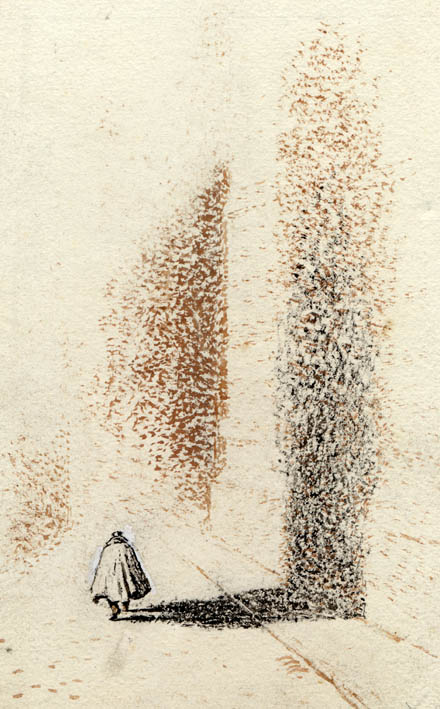
It has been the subject of many films and television versions and a number of illustrators have attempted to capture the terror of Henry Jekyll’s struggles to control his murderous alter ego. An artist who succeeded with dramatic brilliance was Mervyn Peake.

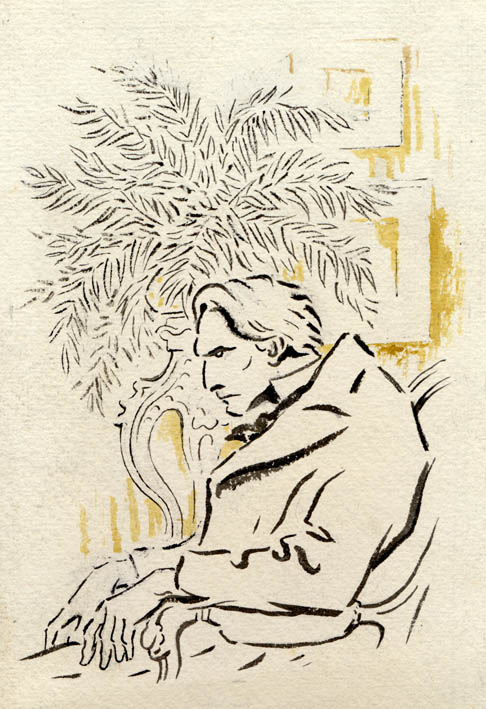
Peake illustrated Dr Jekyll and Mr Hyde for the Folio Society in 1948 with a suite of drawings that demonstrate that the artist clearly understood the need to resist the temptation to merely draw the monster that was the flip-side of the man.

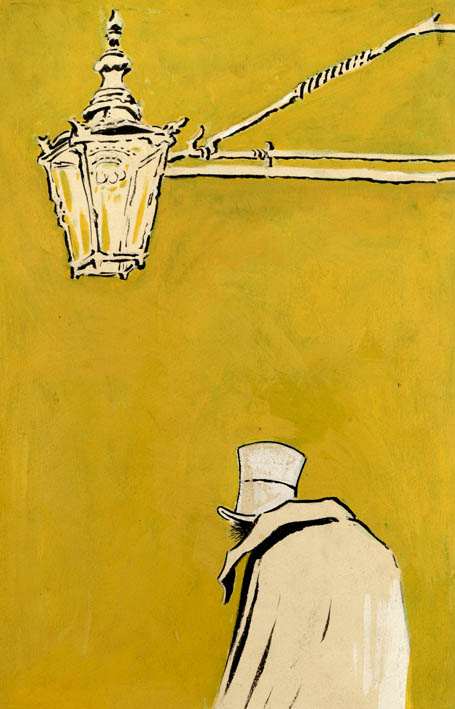
So, whilst he depicted the haunted Dr Henry Jekyll (above right) when it came to Mr Hyde, Peake chose only to hint at the horror, depicting him as scuttling off down alleyways (top left) dwarfed by the city he terrorizes yet, at the same time, casting a towering shadow; or - as shown in the book’s frontispiece - pausing beneath the guttering gas-lamp, the only indication of disease being the hunched shoulders and the unkempt demeanour.


Peake’s economy of design and simplicity of line - almost Japanese in style - and his use of a disturbingly sickly-yellow wash is inspired as can be seen in the illustration of Hyde before the mirror (itself almost animal in form) considering his shrunken frame draped in Jekyll’s too-large clothing….

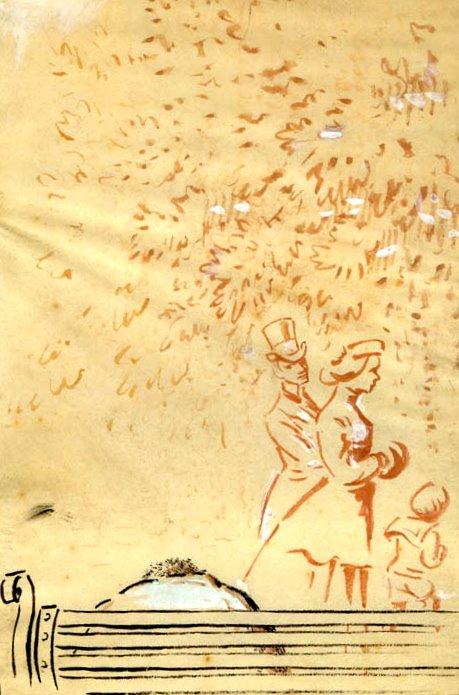
Or, again, in a cunningly contrived drawing of Hyde slumped on a park bench in which the full grotesqueness of his brutish depravity still remains hidden from us but is noted by the upright Victorian gentleman who gives a disturbed backward glance as he passes by with his wife and child…


And so, when Mervyn Peake finally reveals Hyde to us in his bestial form - the simian features, the crab-clawed hand clutching the fateful, upraised phial - the effect is all the more terrible for our having waited for the revelation…


[All images: © The Mervyn Peake Estate]

Tuesday, November 14, 2006

ROCK STAR

Some people might be surprised to find a copy of Jackie Collins' 1988 novel Rock Star on my shelves. Admittedly, it not quite my type of book but it is inscribed, "For Brian with love, Jackie" and is a memento of a fascinating encounter.

I was to interview the author for a programme on the BBC World Service and, to begin with, it did not look set to go well. On her arrival, Ms Collins was clearly in a far from happy mood and snappily observed that she hope that this interview was going to go better than the one she had just recorded for another BBC network.

"Oh," I asked innocently, "What went wrong?" Back came the whiplash reply: "The idiot interviewing me asked: 'Well now, what can I possibly ask Jackie Collins, that she's never been asked before?' To which I replied: 'Why ask me? I thought that was your job!'"

Ho-hum, I thought... I guess I can't do any worse than that! And, mercifully, I did a good deal better - maybe because I'd taken the trouble to actually Ms Collins' chunky doorstop of a novel.

Towards the end of the interview - by which time Jackie and I were clearly getting on considerably better than expectations - I commented on a remark made by one of the characters who had observed:

“Sex is the most important thing in the world - more important even than money…”


“So," I cheekily enquired, wondering if I dared ask the question, "what’s most important to Jackie Collins ---- sex or money?”

“Both!” she replied without a second’s pause, “and, preferably, together!”


"Thank you," I purred.

"No, thank you!" she purred back. "And shall I sign your book...?"

Signed Books: 2 – JOURNEY'S END

Among my collection of signed books are volumes given to me by writers who were also friends along with others by writers, actors and celebr...